

Indoor Meeting: Talk by Barry Gayton "Trees and Shrubs"
- Details
- Written by: Anne McCord
- Hits: 3069
Amelanchier canadensis April flowers in Anne's garden
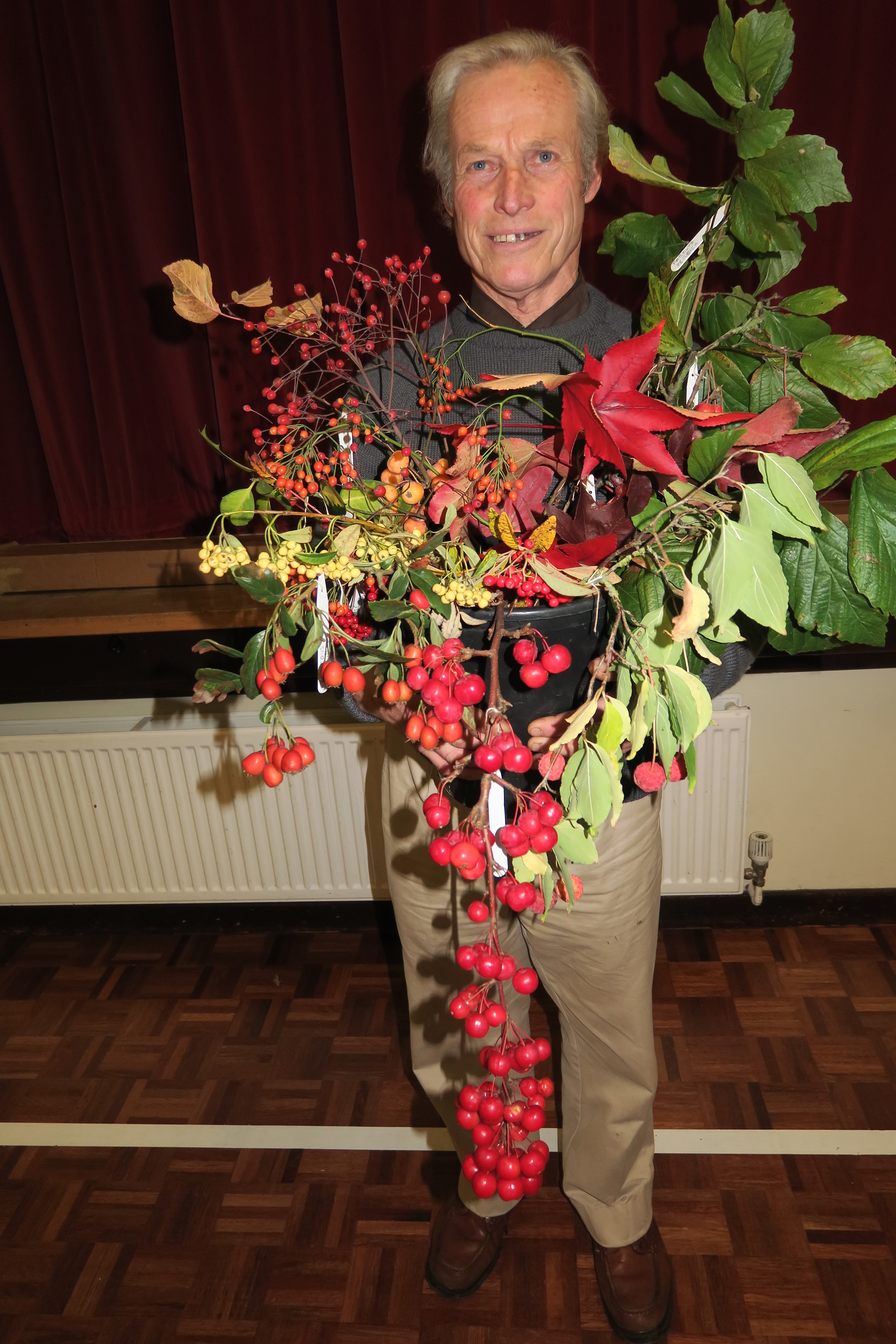
Barry Gayton
Trees and Shrubs
A talk by Barry Gayton. HPS 10 November 2018
Mr Gayton’s talk concentrated on trees suitable for small gardens. Numerous slides were shown of examples including Acers, Malus, Sorbus, Cornus, Euonymus and others with recommendations made for specific varieties. I noted audience members busy writing down the names of their favourites but there were several that I was not familiar with but nevertheless looked interesting.
Sorbus scalaris is a spreading tree to 10m tall with leaves downy beneath which turn to orange, red and purple in the autumn. The small white flowers appear in spring and are followed by rounded red fruits.
Aesculus x mutabilis Induta is a small tree or large shrub and is a variety of Horse Chestnut known as Buckeye. It has palmate leaves and many yellow-flushed pink flowers born in panicles with good autumn colour.
Robinia hispida Casque Rouge forms a small tree with delicate Wisteria-like foliage. Fragrant, drooping clusters of, pea-shaped flowers appear in late spring and early summer and are followed by dark red-brown seed pods in the late summer. This variety has large purple pink blooms rather than the rose-pink flowers of the species.
A favourite small tree of mine is Amelanchier canadensis which grows in my small back garden. It has white flowers in spring set off against coppery foliage, black berries which are quickly devoured by the blackbirds and glorious autumn colour. It can also be pruned successfully to keep it within bounds.

Indoor Meeting: Talk by Dr. Twigs Way "Virgins, Weeders and Queens - a History of Women Gardeners"
- Details
- Written by: Jenny Hodgson
- Hits: 3115
Virgins, Weeders and Queens - a History of Women Gardeners
A talk by Dr. Twigs Way. HPS 8 December 2018
This talk was based on the fascinating book by Dr. Way encompassing the role of women in gardening from Medieval Times to the present day. The Virgins, Weeders and Queens was added to the original title to make the book more saleable!
In the 1600's lower class women were allowed to grow food and medicinal herbs for money - 3p a day while men were paid 6p plus free herring and ale! If a husband who ran a Market Garden died, his wife could run it until a son could manage it. Mistress Tuggie who wrote The Book of Hours for women was just such a lady.
Queen Eleanor introduced hollyhocks and quinces and Queen Mary installed glasshouses at Hampton Court. She had a collection of exotic plants brought back by Captains from around the world. Princess Augusta continued her dead husband's work at Kew, building the Pagoda and Orangery and a collection of plants from around the world.
In the 1800s Aristocratic Ladies could nurture and water their gardens and conservatories. In the 1900s, Surplus Women whose husbands had died became Lady Gardeners. They were often daughters of professional parents and became Head Gardeners of Ladies' Estates.
After the war, ladies became more active. Gertrude Jekyll was the first female garden designer. Many were multi talented as was Vita Sackville West at Sissinghurst. The Land Army changed the role of women gardeners and the clothes they could wear improved their life dramatically.
Dr. Way finished her talk with the inspiring story of Beth Chatto whose wonderful garden many of us will have visited.
Indoor Meeting: Talk by John Cullen "Pollinators in your garden"
- Details
- Written by: Barbara Back
- Hits: 3370

Pollinators in your garden
A talk by John Cullen. HPS 13 October 2018
John is part of a family based nursery in Lincolnshire specialising in plants for the pollinators, scented plants and edible plants since 2009.
Part of his training background was at Hampton Court and he was tutored by Juliet Sargeant. He learnt from her that every plant should have a purpose and so looks for a plant to look good, taste good and be pollinated. He has shown at Hampton Court, Chelsea and Tatton Park.
In his early gardening life he found that good plants were hard to source in London and so started growing his own. John Cullen plants are neonicotinoid-free.
Neonicotinoids are a class of neuro-active insecticides chemically similar to nicotine and are used by some growers as a wash/drenching insecticide. They are used on crops to control pests such as vine weevils and aphids but also kill bees. The insecticide is taken into a plant’s system and there is debate as to whether it remains in the plant system or is diluted over time. It may also be present in it’s seeds. If it is present in pollen and taken back to a hive, the hive will become sterile and collapse.
John's talk covered this reaction on pollinators; bees, butterflies and moths. There are around 250 species of bees in the UK; bumblebees, solitary bees and a single species of honeybee.
Some facts:
Bees
They select plants according to the length of their tongues. If their tongue is not long enough, they will pierce the flower.
They prefer single flowers (not doubles) as it is easier to collect pollen.
They are attracted to plants with scent.
They like herbs that flower.
Solitary bees are likely to pollinate tomatoes, cucumbers etc.
Solitary bees don't sting.
Bumblebees have a lot of predators like tits and badgers.
It's only lady honey bees that collect pollen.
After coming out of (sleepy) hibernation in spring, they tend to go for low plants like pulmonaria.
Butterflies
They taste with their feet - to see if the plant is good for laying eggs.
Ivy and nettles are preferred egg laying sites. Have some in your garden to discourage caterpillars on your favourites.
Butterflies in your garden show that you have a good eco-system.
Moths
Very important pollinators as they are attracted to night scented plants.
When considering plants for your garden think of a year round plant food source for pollinators like flowering shrubs - which often flower twice in a year. Planting in blocks gives a good display but helps pollinators feed easily.
To avoid insecticides encourage birds into your garden especially overwinter.
Did you know you can buy ladybirds? John averages 1000 over 3 acres released in spring.
Keep a corner for ivy and nettles away from your borders for hungry caterpillars.
You can always ask when you buy if the nursery uses neonicotinoids.
You may be aware of the yellow RHS sign on plants indicating that a plant is "bee" friendly. You may find this press release from RHS last year interesting. http://press.rhs.org.uk/RHS-Outreach/Press-releases/How-to-bee-friendly-this-summer!.aspx
Garden Visit: Parham Hall, Woodbridge, Suffolk
- Details
- Written by: Mavis Smith
- Hits: 4681
8th September{module Garden Visit: Parham Hall, Woodbridge, Suffolk}
Photos by Chris Davies
This was a garden visit full of surprises, as we progressed through the garden it just got better and better.
At first, parking beside of a large sandstone house, I thought ‘This is strange, where is the grand entrance’. This was soon explained by our hostess. The property was inherited by Sue and Adam Paul in 1972. Sue explained that less than half of the original Hall remained, the front half having been demolished many years ago. The boundary and foundations of the larger hall were clearly visible after this very hot dry summer, and the previous formal garden was no longer adjacent to the remaining house.
Sue and Paul’s initial problems were to make the remaining ‘back end’ of the original hall into a respectable house and to redesign the garden area. The reconfigured house was surrounded by extensive lawns, some close cropped, others were wild areas. It was almost parkland with many splendid ancient trees, all looking in good health and with beautiful shapes. Obviously, some have had to be removed and there are now many new plantings to take their place. Around the house there are now borders and a terraced area. A series of island beds have been planted some distance from the house, mainly bergenias, euphorbias and stipa gigantea. A Lutyens bench was surrounded by beautiful pink double cosmos. Many of us vowed to grow more cosmos next year.
We wended our way through the trees and came to a door in a brick wall. Inside, one could immediately appreciate the beautifully planted walled garden. The entire area of around ¾ acre was surrounded by a lovely mellow red brick crinkle crankle wall, apart from one area that was open to a pond.
At the centre was a large medlar with a circular bench around its base. From here paths radiated out to divide the garden into four quadrants. The central path was a covered arch of vines and roses. At right angle to this the paths were lined with apple and pear cordons. One half of the garden consisted of a grassed orchard of apple, plum and pear trees. The other half was devoted to vegetables, soft fruit and flowers for cutting. Many varieties of vegetables are grown including jet-black tomatoes, cape gooseberries and a very attractive row of the brown flowered Amaranthus cruentus. The concave areas of the walls were planted with trained fruit trees – pears, figs, cherries, peaches, kiwi and even a pomegranate.
A range glasshouse along the south wall housed grapevines and a selection of peppers. In the south wall another door led into a frame yard. The frames were mainly empty at this time of the year. A ‘bothy’ backed onto the south wall, where all the tools were still housed, many of them antique and well oiled, there were racks of clay pots, an old soil steriliser and raffia for tying. On the opposite wall was a glasshouse below ground level, reminiscent of a pineapple pit, but now so useful for storing plants needing winter protection.
Yet another entrance in the east wall led to another small walled area planted with herbs around the wall with a formal diamond design central area. One final door led into a converted byre where there was tea, coffee and a wonderful spread of cakes and sandwiches. I had been so interested in the garden that I had forgotten that refreshments were included in the visit!
Mavis Smith
Page 20 of 32